Isomorphism and Uplift.
Ryan Carroll has written an account of a conversation we had back in September 2025 for The Jesuit Media Lab, “Isomorphism and Uplift: The Ignatian Imagination of Peter O’Leary.” It’s quite wonderful.
Ryan writes:
O’Leary’s words have imprinted themselves into my brain and have knitted themselves into my spiritual life. When my intellectual and my spiritual life threaten to come apart, when I struggle to feel that which I know, I turn to O’Leary’s poetry. In it, I feel something like the ecstatic life I feel in Ignatius’ Contemplation to Attain Divine Love, which asks us to see the shower of divine blessings descending on the world and returning to God — an abounding energy pulsing in all things.
Thanks, Ryan!
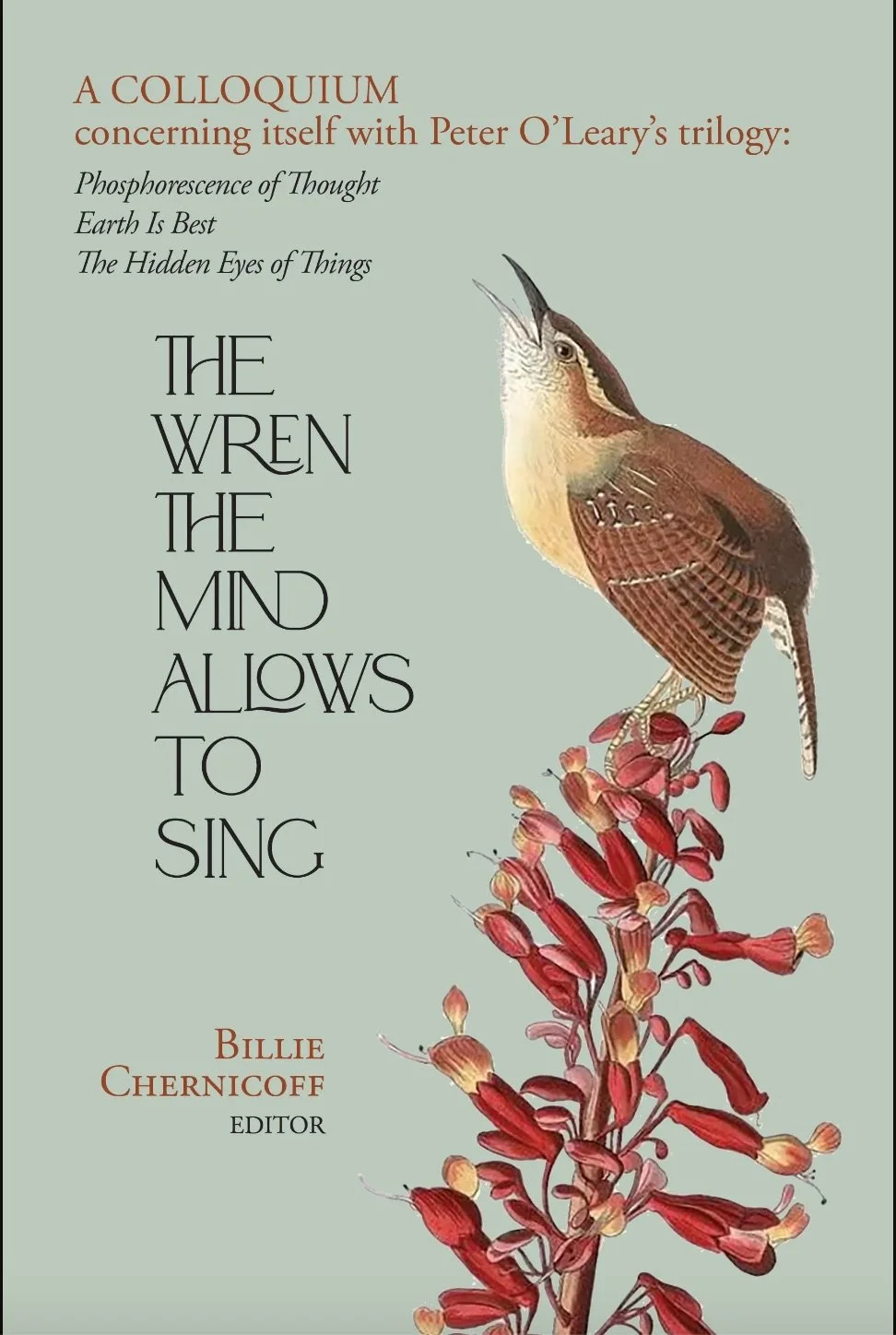
Also: Phosphorescence of Thought is out of print. There are plans to reprint it. In the meantime, here is a PDF of the final page proofs.
And finally, a call back from twelve years ago, when Ismael Belda wrote a review of Phosphorescence of Thought in Revista del Libros. Here is a translation of the review.
Poets, where are the long poems of the future?
Ismael Belda
I'm reading Phosphorescence of Thought by Peter O’Leary (New York, The Cultural Society, 2013), an astonishing poem that has exactly the same number of verses as Walt Whitman's Song of Myself. It's a poem about consciousness, about planet Earth, about the birds that inhabit a certain Chicago suburb, about the seasons, about animals, about life on Earth. It speaks of the personal and the universal, rising in a mysterious double helix toward a common goal. It blends science and something we could call mysticism, if we didn't have a more precise word: poetry. It unfolds in prodigious, incredibly beautiful enumerations. Walt Whitman, William Blake, Euripides, William James, Georg Trakl, and Emily Dickinson are presences that hover over the text, sometimes in the form of more or less explicit intertexts, or directly as complete translations—or rather, personal adaptations—(as in the case of Trakl's poem "Helian," which constitutes one of the chapters or cantos of the book). The title comes from a text by Pierre Teilhard de Chardin that reads: "For a Martian capable of analyzing sidereal radiations in both a psychic and a physical way, the first characteristic of our planet would not be the blue of the seas or the green of the forests, but the phosphorescence of thought." Teilhard de Chardin imagined "a majestic assembly of telluric layers" on our planet, the last of which, upon contact with the "spark of consciousness," ignites "until the entire planet is covered in incandescence." There is an attempt in the poem to show that human consciousness and nature (plants, animals, the Earth) have inextricably linked destinies. Nature engenders forms according to a particular energy, O'Leary seems to say in some passages, and that particular energy through which animal, plant, or terrestrial forms spring forth is identical to visionary imagination, which manifests itself in poems like this one. It speaks of bird migrations and the transmigration of souls, of autopoietic structures and environmental pollution (tragic and yet, at times, so beautiful). There is a permanent, splendid, and heart-wrenching celebration of the world, and the language of the poem is profoundly visionary, of such richness, sensuality, and ductility that one is astonished on every page, almost in every verse. I finish the book dazzled, happy, envious.
I tell myself: here is a poet who has written a long, unified poem, with the ambition of being global: that is, global in the manner of the cosmic poems that have always been written, from Parmenides to Whitman. When was the last time I read something like this in Spanish? Of course, in the United States there is a broad lineage that stems from Emerson, Thoreau, and Whitman, in which O'Leary clearly fits. It is a tradition that favors the visionary, the union with (or the internalization of) nature, the explicit and mutual interpenetration of inner and outer worlds, the infinite, unattainable praise, as Rilke would say. One might think that this intellectual lineage makes it easier for miracles like O'Leary's poem to emerge there (although, obviously, we have other valid traditions). Of course, if we think about the Spanish-speaking world, there is something in Phosphorescence of Thought that recalls Ernesto Cardenal's Cosmic Canticle, but that great poem by the Nicaraguan (whether one likes it more or less, and it is well known that with Cardenal, love equals hate) is unique in our language, without ancestors or successors. Contemporary poetry in Spanish has moved further and further away from long forms, and, with several honorable exceptions (and when one starts to think about it, the exceptions are always more numerous than expected), the 20th century was a century of short poems. I think about all this and I turn to Juan Ramón Jiménez, who in his prologue, precisely to one of the great long poems in Spanish of the century, "Space," said: "The long poem with an epic theme, a vast mixture of general intrigue of substance and technique, has never attracted me; I cannot tolerate long poems, especially modern ones, as such, even when, because of their best fragments, they are universally considered the most beautiful in literature. I believe that a poet should not labor to "compose" a longer poem, but rather save, preserve the best stanzas and burn the rest, or leave the latter as supplementary material." And then, even though one almost always heeds Juan Ramón in everything, I discover in myself, for the umpteenth time, a secret nostalgia for precisely what the universal Andalusian denigrates: that "long poem with an epic theme, a vast mixture of general intrigue of substance and technique."
I think of certain long poems that, with the arrival of the postmodern era in literature (particularly in American literature), adopted the new form of the long poem, a form that, in my opinion, is not only valid but also necessary. Narrative, playfulness, hybridization (things that were already hinted at in the great modernist poems of the first half of the century, such as those by Ezra Pound, T. S. Eliot, Wallace Stevens, and William Carlos Williams). I'm thinking of James Merrill's The Changing Light at Sandover, an immense work of Proustian and Nabokovian scope, wonderfully colloquial and funny at times, in which the author recounts the contacts he and his partner, David Jackson, established over many years through a Ouija board with dozens of spirits, including Auden, Yeats, Wallace Stevens, and the archangels Michael, Raphael, and Gabriel (in a recent, and otherwise excellent, Spanish translation of his book Divine Comedies, the first part of The Changing Light at Sandover, "The Book of Ephraim," was unfortunately omitted, although it is included in the original book); I'm thinking of Kenneth Koch's The Duplications, a wild and wonderful journey in ottava rima whose protagonists are Mickey and Minnie Mouse, Donald Duck, and Pluto, who participate in a car race across Greece. In the poem, among many other wonders and absurdities, there appear some girls called the Early Girls, exquisite, almost incorporeal beings, made of Finnish soil, who each time they make love cause a replica of a city from around the world to materialize; I'm thinking of John Ashbery's Girls on the Run, a long poem based on the adventures of the Vivian Girls, the girls who inhabit the worlds created by Henry Darger.
In these three examples, which are, moreover, enormously different from each other, one senses that infinite freedom that is characteristic of the long poem. We can do whatever we want in a long poem, we can start wherever we want and end wherever we want, we can put everything in it, all our life and all our dreams, we can play and digress, pray and preach, be serious and crack jokes. We are not slaves to the continuity requirements of a novel and can accumulate thousands of nodules of lyrical flight and mix them, superimpose them, make them transparent, exchange them. And we can also be prosaic, be systematic like novelists, be romantic, be libertine, be like Carthusian monks, be cultured and streetwise, be whatever we want to be.
The ambition to put everything into a long poem: verse, prose, diary entries, other people's poems, newspaper clippings, narration, song, dialogue, polyphony, low language, high language, invented languages, composite languages, mutant languages, science, magic, history, science fiction, rhyme, free verse, new metrical forms, forgotten metrical forms, memories, dreams, abstractions of thought, music, encyclopedism, raw realism and unbridled fantasy. The ambition, I say, to make a long poem with all this produces a desire to carry it out so strong, so irrepressible. How is it possible that all Spanish poets resist it? Oh, land of austere monks of cell and scourge!
Poets of Spain, set aside (even if only for a while) your haikus and your malnourished, anorexic poems: let the time of torrential verse return, of poems like cathedrals, like immense train stations, like mountains, like spaceships, like mother ships, like arks, like constellations or cyberspaces. Let's try to do something great for once, because we are dying, oh my brothers, my fellow men.
Peter O'Leary (Detroit, 1968), by the way, is a professor at the Art Institute of Chicago and earned his doctorate in Theology some time ago. Some time ago he gave a course that consisted of reading John Milton's Paradise Lost, followed by William Blake's The Marriage of Heaven and Hell; Philip Pullman's trilogy His Dark Materials and Ronald Johnson's Radi Os (one of the first examples of erasure poetry, which in this case consisted of selectively erasing fragments of Milton's poem to transform it into something else) are among the works mentioned. Ronald Johnson, one of his mentors (upon his death, he named O'Leary his literary executor), is the author of ARK, recently published by O'Leary himself in a sumptuous volume designed by Jeff Clark of Flood Editions (Chicago, 2013). ARK, an inexhaustible and almost infinite poem, is a vast attempt to capture the entire universe through visionary imagination. Its structure resembles a grand building, or an enormous spaceship. Its different parts are titled "The Foundations," "The Spires," and "The Walls." Its final line is "countdown for Lift Off."