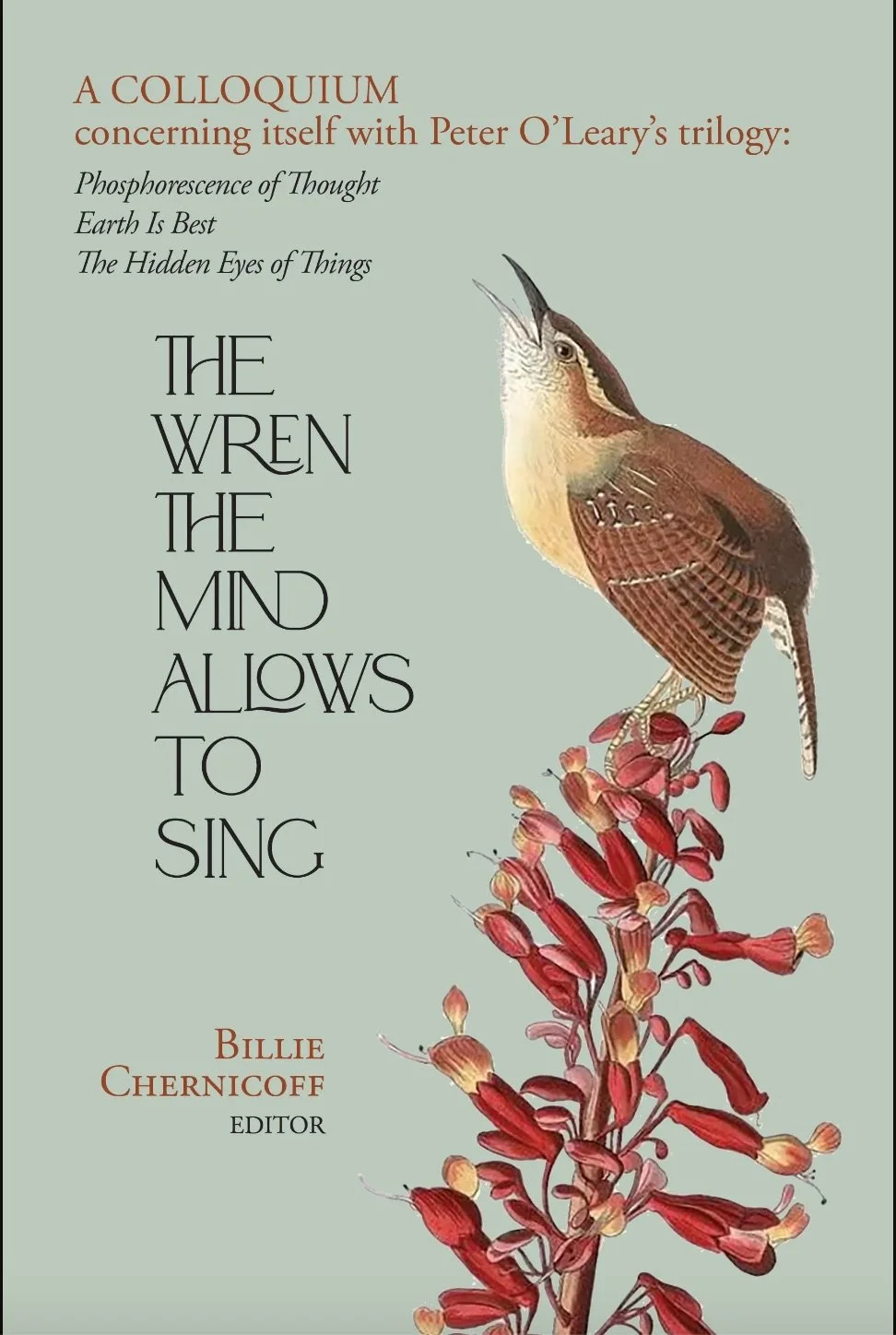
The Wren the Mind Allows to Sing
In case you haven’t heard, in 2025 Dos Madres Press published a book about my trilogy on consciousness, The Wren the Mind Allows to Sing, edited by Billie Chernicoff, and including contributions from Dan Beachy-Quick, Billie Chernicoff, Norman Finkelstein, Elizabeth T. Gray, Jr., Whit Griffin, Devin Johnston, Emily Tristan Jones, Devin King, Márton Koppány, Steven Manuel, Thomas Meyer, Patrick Morrissey, Michael O’Leary, Kylan Rice, John Tipton, Steven Toussaint, G.C. Waldrep, and Stephen Williams.
The book is a “Colloquium concerning itself with Peter O’Leary’s trilogy,” which consists of Phosphorescence of Thought, Earth Is Best, and The Hidden Eyes of Things.
Introducing the book, Billie Chernicoff writes:
We set out to read the three books of Peter O’Leary’s trilogy on consciousness: Phosphorescence of Thought, Earth Is Best and The Hidden Eyes of Things. Read we did, thoughtful and mirthful, from the 1st of May through the 9th of June, 2023, 40 days and 40 nights.
Here is our logbook, and our dove.
Billie Chernicoff
12 June 2023
In his preface, Thomas Meyer writes:
This work we’ve been pondering never loses its tensegrity, to invoke Buckminster Fuller. Its openness is a fretwork at times. Close weave at others. Caution, I tell myself, looking at the brilliance of critical approach and amplifying notation, the voices joined herein. Is this the charisma of age? No, just aging. To realize the world as a nine-year-old once aspired to, that of Bennet Cerf and Arlene Frances, mid-century Manhattan. Scary, long night, we endured before the dawn of pop art. No, this isn’t self-indulgence on my part, Peter’s range of voices sideswipes gangster movies and Spenser’s Faerie Queene to our shared delight.
Latter-day Goethe. It fits. The natural world, mushrooms and birds, the classical, Peter’s Latin and Greek, his soulful sojourn in Vienna an “Italian Journey.” Or so we discover in this colloquy when dialogue resounds rather than resolves. A Time Machine, it feels like, returning to Berkeley in the late fifties with Jack Spicer, Robert Duncan, Robin Blaser, and thus, to that last serrated edge of Modernism. Still shaken to the core by Yeats’s late poems, especially compared to Pound’s Personae and the impending fragmentation of his Cantos alongside Eliot’s midlife abandonment of poetry. Nearly wrecked upon this reef, we see the lighthouse in time, manned by Charles Olson, and how our poetry can contain a prospect, it can, it will be a projection in and of its glorious self.
—Thomas Meyer